Showing posts with label Activity. Show all posts

Friday, November 12, 2021

eReading Worksheets


If you are a teacher of reading, English, or language arts, you have most likely stumbled across ereadingworksheets.com in your search for ready-to-use (or ready-to-adapt) materials. 

This website, created and updated by education enthusiast Donald Morton, offers a plethora of standards-based resources focusing on essential comprehension skills.

Online test item
In addition to hundreds of printable reading worksheets, Mr. Morton has updated his resource site to include interactive assignments! This includes online tests and digital games. Check out Genre Piranha, a literary genre review game, or Poetry Cat, a fun and uniqe approach to learning figurative language!

All resources on the site are searchable by grade level and skill, so finding the appropriate resource to meet your teaching needs is a breeze. Mr. Morton also includes answer key sheets, PDF and RTF options, as well as a preview of each resource. 

The resources on ereadingworksheets.com can be used as is, or altered and adapted to fit your students' learning needs. 


Saturday, September 3, 2016

Text Code Key

As many of you probably know, the concept of metacognitive active reading - more specifically annotations - is abuzz in the education world. In an earlier post, we shared an activity that included using text codes an annotations to monitor thinking while analyzing poetry, spoken word, and songs.

This upcoming school year we are introducing text codes up front. Students will be introduced to the concept of annotations (we are beginning with sixth graders) with a guided lesson that delivers instruction through modeling. We will first present the Text Code Key (a poster will hang in the room and each student will receive a copy of the key to which they can refer when they use the strategy independently).


Click to view. Make a copy to edit.

Next, students will be introduced to the Vale MS Article of the Week. Because we are approaching the curriculum thematically, the classes will be assigned one AoW on a topic related to the essential question(s) each week for the duration of the unit.

I like to use a projector and write on the white board (an older-style projector or any projection camera device will work), so for modeling the text coding strategy I will project a digital copy. All students will have copies of the article and we will preview the text and conduct a shared reading of the article. This allows students to hear how I make connections and ask questions about the text as I read and encourages them to do the same using their personal background knowledge.

During Reading:  Using the text codes from the key, I will draw the text code in the text and make a note to accompany that code in the margin (space is provided on the article handout). You can set a minimum of codes/annotations for students to make, but it's about quality not quantity.

Students volunteer to share their thinking, and this encourages an analytical conversation. The rest of the Article of the Week assignments (embedded responses) will be done independently for classwork or homework, or can be done in pairs. 

This strategy can work with any genre of text. It incorporates several strategies, including analyzing word choice, purpose, and perspective, as well and making inferences and drawing conclusions based on explicit, implicit, and background information.

As always, please feel free to Make a Copy in Google Doc, adapt, and share!


Wednesday, May 11, 2016

Interactive Review: IXL

We are absolutely loving the IXL 30 day free trial!
Click to sign up for your free trial!

The free trial gives teachers (or parents) and students full access to all of IXL's tools, including real-time progress and student scores by state standard or objective.

IXL is fully aligned to Virginia and other state standards.

IXL is fun and engaging. Students complete questions that reflect TEI (technology-enhanced items), such as multiple answers, open-ended questions, or manipulating answer choices; it's not the typical passage-reading and answering multiple choice questions.

IXL is more of an instructional tool than an assessment tool. It is definitely a mode of formative assessment. Students are able to track their progress, and if they get an item incorrect they get immediate feedback explaining why their answer was wrong and why another answer choice was correct.

Student view: Connotation interactive


This is great to project and do guided questions with a group of students. It also serves as a wonderful computer station for a blended classroom!

Give it a try, and let us know how you use IXL!

Saturday, May 7, 2016

Main Idea Cards

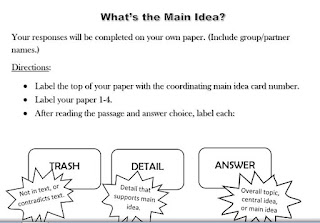
Have you tried our Main Idea Cards?


This strategy is a great way to improve reading comprehension with metacognition and close reading. It also helps students gain skills that align with Common Core and state standards.

Click do download PDF

Students struggle differentiating between topics, main ideas, and summaries. This strategy scaffolds understanding of components of a text and instructs students on how to differentiate between a supporting detail, "trash" (a statement that contradicts the text or is not found in the text), and the main idea. It also shows students how a topic, main idea, and supporting details compose a paragraph.
Click on the image to view the presentation in Google Slides. To access an editable copy, click File then Make a Copy, and Rename the presentation and Add it to your Drive. You will then have a copy that you can adapt for the needs of your students. Please share! We welcome your feedback :)
Click to view Slide. Make a Copy to Edit.

Sunday, April 3, 2016

NY Times Found Poetry Contest

Click for NCTE PDF on Found and Headline Poetry
The New York Times announced on March 31st that submissions for their 7th Annual Found Poetry Contest are now being accepted.

Not only is this contest an excellent enrichment activity for students performing above grade level, but it also includes the components of a balanced literacy lesson.

The activity requires students to read, analyze, and ultimately choose a NY Times article (or two) to summarize, personalize, and manipulate into a "found poem." This is a multi-step process that requires direct instruction, modeling, analyzing mentor texts, guided reading, and independent reading (as well as re-reading). 

From comprehension to application to synthesis in the areas of both reading and writing, this extension activity will get students actively engaged with an opportunity to lend their voice to a published article or text.

Here are the guidelines from their website:
– Each poem must be 14 or fewer lines.
– You may give it your own original title if you like. The title does not count as one of the lines.
– Your sole source material must be Times pieces. You can use up to two articles. (Note: This is a change from previous years, when we allowed you to mix words from as many items as you wanted.)
– The poem itself should use no more than two of your own words. The rest of the words and phrases can be mixed up any way you like, but should all come from The Times.
– You might choose to write in a traditional poetic form, or not.
– Poems may be submitted by groups or by individuals. Only one poem per person is allowed, however.
– You must be from 13 to 19 years old but can be from anywhere in the world.
– You must post your poem as a comment on this post by 7 a.m. Eastern time on May 3.
– At the bottom of your found-poem post, please provide us with the URL(s) of the article(s) you used.
– Though The Learning Network often publishes excerpts from literary and historical works on our blog via our Text to Text andPoetry Pairing features, those are off limits for this contest. The Times articles they are paired with are, of course, fair game

Note: Our commenting system doesn’t recognize fancy spacing, so using words to create interesting shapes is, unfortunately, not an option

Saturday, April 25, 2015

Word Mover Station

Word Mover by ReadWriteThink


As we have been implementing poetry stations over the last several weeks, I came across ReadWriteThink's Word Mover activity.


This may be news to you, but I hadn't ever seen it before. What a great station tool! Students can sit at the computer station (or tablet or other electronic medium), and create their own poem interactively!

The only thing I added to the station directions for this station was the poetic form. Depending on how much time you have, and if you choose to have them use one of the pre-loaded texts, including a specific type of poem (haiku being the most simple and a sonnet or multi-stanza ballad being more tedious and time consuming) is a great way to reinforce state and common-core standards. 

They can save their work, share it with you (say, in Google Classroom or Drive) or print a paper copy to turn in. What fun!


Poetry Stations Page Updated

Poetry Stations Updated!

As promised, the Poetry Stations are now posted! Student directions, materials, and printables are now available for download on the "Poetry Stations" page. 


Click for Poetry Presentation Guided Notes
Click for Poetry Presentation
You can also access the downloadable Poetry Stations Book, as well as the Poetry Presentation with guided notes, below!


Click here to download Poetry Stations Book.


Mood and Tone: Analyzing Different Poems on the Same Topic


Mood and Tone:  Analyzing Different Poems on the Same Topic

After reading and viewing videos of poems on the same topic with different moods and tones (and discussing the differences as a class), students independently completed a classwork assignment in which they were given words that represented each tone and mood and asked to match the descriptor to the appropriate poem.
This will lead into a word choice activity that moves from the poetry unit to a unit that encompasses diction and word choice in various types of prose. 
Click to download handout.

Click to download handout.

A copy of "Ode to Mi Gato" can be accessed here.


Monday, April 13, 2015

Antonym Sort

Go beyond basic antonym recognition with this higher-order thinking antonym sort. This can be a color-coded sort, a cut-and-paste sort, or students can fill in a blank sort with the words on a separate sheet. 

*The example is color-coded as an answer key.

With this activity, students must apply their knowledge of word meanings and word relationships, as well as connotation and diction. 

Find this and other word study sorts and activities on the Stations: Word Study page!

Click to download Antonym Sort.

Saturday, April 11, 2015

Synonym Sort

Click to download Synonym Sort.
This synonym sort reflects the types of a analytical word study questions asked on state tests.

This sort can be used as a station or as a partner or whole-group activity, and it can be a cut-and-paste sort or a color-coding sort. Adapt as needed to differentiate for your students.

You may want to give students access to a print or electronic thesaurus or dictionary for this sort.

This goes great with the "One of These Words is NOT Like the Other Words" presentation with activities found in the earlier post. Find more word study activities to help students practice connotations, synonyms, and antonyms on the Stations: Word Study page!


Thursday, April 2, 2015

Close Reading with "Thank You, Ma'am"

I may be behind the curve, but I am so excited to have been introduced to Kylene Beers's Notice and Note Signposts close reading strategies! 
No, I don't have the students use sticky notes to post all over a text - but I so think the "look fors" are wonderfully effective for close reading.
With my seventh and eighth-graders, we did a "cold read" of Langston Hughes's very short story, "Thank You, Ma'am" (after viewing a presentation and taking brief notes on each signpost). We did a second - close - read of the text with the graphic organizer below. Instead of asking why the signpost (event) is important, I found it more effective to ask students to make an inference, draw a conclusion, or make a prediction about either the future events of the story, the character, or the impact on the plot, conflict, or theme. 
It was great! The students were engaged, knew clearly what their goals were for the close read, and were able to analyze and understand the text much more deeply than with any other fiction reading strategy I have tried.
Have you tried this strategy? I'm excited to hear about other texts that teachers have tried with the signposts and what kind of graphic organizers you've adapted that work for students! Please share!


Click here for strategy handout.

Tuesday, March 31, 2015

One of these Words is Not like the Other Words...

New activity for word relationship and word study practice! 

This Google Slides presentation reviews word relationships, word origins, and helps students make associations among related words.

The activities in this presentation align with the multi-step cognitive processes found in Common Core and SOL assessments. 

This could be broken down into sections as warm-ups for whole-group practice, divided into sections and made into stations, or made into a review game! 

As always, feel free to share and adapt as needed!


Click slide to view Google Slides presentation.

Saturday, March 28, 2015

Poetry Book

Update April 2016: Check out the new poetry stations added to the Stations: Reading Page! Link on the homepage.

Here is a sneak peek at Candace's newest station rotation! We reunited to introduce stations that reinforce concepts of figurative language, poetic devices, and mood and tone created through word choice. 

The students were so proud of their final products, and they were eager to share their final products at the cumulative "Poetry Jam" that would wrap up the unit.

The Poetry Stations page is under construction, but click on the Poetry Book Link below to see the activities and instructions!

Students cut out lines for a 'found poem'

Students illustrate their poster poetry.

Students sort through words for magnetic poetry.

Click to download Poetry Book template.

Reunited for station rotations!


Monday, March 23, 2015

Author's Perspective: Objective and Biased

This activity is very effective in allowing students to investigate author's perspective and the subjectivity of a topic.  

They are tasked with writing down facts from an article, forming opinions about the content of the article, and eliminating bias and rewriting the article from an objective viewpoint. 

Saturday, March 21, 2015

Mark My Words Paraphrasing Activity

This activity allows students to practice summarizing and paraphrasing.  It is imperative that students do not change the meaning of a text when rewriting or citing what someone else aphas written. This activity helps students understand how to incorporate evidence from another text without plagiarizing.

Click to download "Mark My Words" Handout

Thursday, March 5, 2015

Fortune Cookie Stations

Try this unique station idea for assigning mystery topics for students!


Make fortune cookies out of paper. There is a great tutorial by Simply Modern Mom on this blog. The paper cookies are super easy to make; which is important, because you'll be making quite a few!

Write research topics, writing prompts, or story starters on strips of paper and seal them inside your cookies. Place them in a jar or Chinese food to-go container (which can be ordered online in bulk or picked up at your local dollar store).

This is a fun way to engage students by incorporating an element of mystery into a writing or research activity.

Text Translation Station

One of the stations on the Stations: Writing page is the Text Translation station. At this station, students are given text messages to read and interpret. The assignment is to work cooperatively to translate the text into proper English using correct mechanics, capitalization, and spelling. 


I created the handout using Microsoft Word, but it's time for an update! I may be late, but I just discovered iPhone Fake Text, a website that looks so authenic it knocks my fake messages out of the park. 


We will definitely be using this app to recreate our station handout! Make your own Text Translation activities using the site here. http://iphonefaketext.com/


SHARE SCREENFacebookTwitterLinkedInPinterestDownload
Operator2G3G4GWIFI
 Time :  Auto
 NameBlur
When u comin thru?
Gimme like 10 mo mins
U said tht 30 min ago!!!!
Ikr my moms is makin me help her do sum stuff first gimme 10
SendReceive Auto


Saturday, February 28, 2015

Disney Pixar's "Up" Inference Activity


This is a great activity for students to apply what they know about body language, music, and setting to draw conclusions about what is happening this movie clip.

There is a silent montage in "Up" that begins with Ellie and Carl's wedding and takes viewers through the hardships they experience together, as well as Carl's life when Ellie is gone.


This is a great movie, and the scenes evoke many different emotions.

You may want to go introduce the activity, watch the clip (available on YouTube), review the questions, then watch the clip again. It's interesting to see how the student responses differ based on their background knowledge.

Download the PDF here:


Friday, February 27, 2015

Check Yourself! Inference Station

Students love our newest literacy station!
The "Check Yourself" station can be found under Stations: Reading.


At this station, teachers print out several checks (already created for you), and students must make inferences to determine what major life events occurred in order for this person to make the purchases! 

It requires higher-order thinking, but is also fun and a great cooperative learning activity.


Saturday, June 7, 2014

End-of-the-Year Stations

So, the school year is coming to a close. Testing is over, but you still have instructional time. How can you conduct class while still maintaining structure?
Try stations!
Literacy stations that incorporate group collaboration, hands-on activities, and challenging games make for great end-of-the-year review.
There are plenty of board games that involve making inferences, math, and literacy skills.
Check out the games and interactives link on our site for ideas and printable handouts!