Showing posts with label Presentation. Show all posts

Saturday, May 7, 2016

Main Idea Cards

Have you tried our Main Idea Cards?


This strategy is a great way to improve reading comprehension with metacognition and close reading. It also helps students gain skills that align with Common Core and state standards.

Click do download PDF

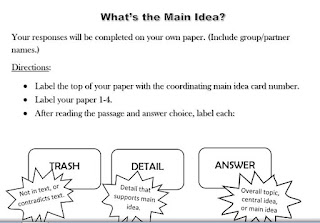
Students struggle differentiating between topics, main ideas, and summaries. This strategy scaffolds understanding of components of a text and instructs students on how to differentiate between a supporting detail, "trash" (a statement that contradicts the text or is not found in the text), and the main idea. It also shows students how a topic, main idea, and supporting details compose a paragraph.
Click on the image to view the presentation in Google Slides. To access an editable copy, click File then Make a Copy, and Rename the presentation and Add it to your Drive. You will then have a copy that you can adapt for the needs of your students. Please share! We welcome your feedback :)
Click to view Slide. Make a Copy to Edit.

Sunday, April 3, 2016

Text Coding: An Analytical Approach

Text coding is a great tool for metacognition. Like other forms of annotating, text coding allows readers to actively track their thinking and monitor their comprehension. Instead of open-ended annotations, text-coding allows teachers to assign symbols (or codes) to specific metacognitive meanings that engage students and prompt them to "think about their thinking."

Text-Coding Chart from our most recent Poetry Unit.
Our most recent educational endeavor has focused on strategies that encourage teachers to move poetry and verse out of April (National Poetry Month; which inconveniently coincides with standards-based test review), chop it into slivers of mini-lessons and activities, and sprinkle it throughout the curriculum map.

It is common practice that poetry is taught in isolation with a strict skill set:  poetic devices and figurative language; even though said conventions are not limited to poetry and verse. In order to link conventions, forms, and structures of poetry to prose, we have to teach students to read and analyze poetry the same way we scaffold understanding and comprehension of prose.

Text coding is a great starting point. Once students annotate the text and monitor their thinking, they then have the tools to analyze, summarize, and synthesize (as it is becoming common to see poems as parts of paired texts and passages used to assess comprehension skills on standardized tests)

The text codes we chose to use are digitally-generated symbols. This lesson (which we will publish shortly) culminates with an independent activity in which students collaboratively text code and summarize a poem (chosen from a variety of genres and accompanied by video/audio) in Google Slides, then work cooperatively to generate questions using SOL stem-starters (after modeling and practice). Students are able to manipulate the text codes in Google Slides by copying and placing their chosen symbols directly into the text and using the Comment icon to share their thinking with their partner or group members.

Click on the Text Code image to view the Slide in Google. Want to edit? To access an editable copy using Google, open the Slide or Doc, click on File, then click Make a Copy. Rename the document and enjoy full editing rights.

As always, please modify and adapt as needed for your students, and feel free to share!

Saturday, April 2, 2016

Literacy Station Inspiration to Present in June


Once again, we will be sharing strategies and collaborative activities at a K-12 Literacy Conference! Come join us! 
(Hurry! The registration deadline for school groups is April 8th!)

We will be presenting a blended (partially online) writing unit that incorporates student-generated writing lessons, process writing instrution, formative assessment, and collaborative learning at the 2016 Center for Workforce and Community Education Literacy Conference for K-12 Teachers. The program is sponsored by the Germanna Education Consortium in conjunction with the Spotsylvania County School's regional Leadership Learning Exchange Conference


The literacy conference will take place on Thursday, June 23 2016 at Chancellor Middle School in Spotsylvania, Virginia with featured and keynote speakers, local educators, and VDOE staff members presenting on current best practices, innovations in 21st century teaching, and new changes or announcements related to the Virginia SOLs.


For registration and session information, see the Conference Flyer or contact Kim Rodenberg at (540) 834-1925.


We hope to see you there!

Tuesday, March 31, 2015

One of these Words is Not like the Other Words...

New activity for word relationship and word study practice! 

This Google Slides presentation reviews word relationships, word origins, and helps students make associations among related words.

The activities in this presentation align with the multi-step cognitive processes found in Common Core and SOL assessments. 

This could be broken down into sections as warm-ups for whole-group practice, divided into sections and made into stations, or made into a review game! 

As always, feel free to share and adapt as needed!


Click slide to view Google Slides presentation.

Sunday, June 8, 2014

Station Expectation Slideshow

We've been meaning to upload our Literacy Station Expectation Slideshow example, and here it is! Please feel free to download, manipulate, and adjust as needed. Modeling is essential to successful station implementation and walking students through the process, whether it's their first time or fortieth time, can make a huge difference on the outcomes of their behavior, and motivation.