Showing posts with label Handouts. Show all posts

Saturday, May 7, 2016

Main Idea Cards

Have you tried our Main Idea Cards?


This strategy is a great way to improve reading comprehension with metacognition and close reading. It also helps students gain skills that align with Common Core and state standards.

Click do download PDF

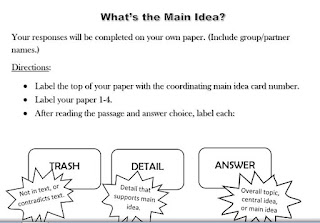
Students struggle differentiating between topics, main ideas, and summaries. This strategy scaffolds understanding of components of a text and instructs students on how to differentiate between a supporting detail, "trash" (a statement that contradicts the text or is not found in the text), and the main idea. It also shows students how a topic, main idea, and supporting details compose a paragraph.
Click on the image to view the presentation in Google Slides. To access an editable copy, click File then Make a Copy, and Rename the presentation and Add it to your Drive. You will then have a copy that you can adapt for the needs of your students. Please share! We welcome your feedback :)
Click to view Slide. Make a Copy to Edit.

Sunday, April 3, 2016

Text Coding: An Analytical Approach

Text coding is a great tool for metacognition. Like other forms of annotating, text coding allows readers to actively track their thinking and monitor their comprehension. Instead of open-ended annotations, text-coding allows teachers to assign symbols (or codes) to specific metacognitive meanings that engage students and prompt them to "think about their thinking."

Text-Coding Chart from our most recent Poetry Unit.
Our most recent educational endeavor has focused on strategies that encourage teachers to move poetry and verse out of April (National Poetry Month; which inconveniently coincides with standards-based test review), chop it into slivers of mini-lessons and activities, and sprinkle it throughout the curriculum map.

It is common practice that poetry is taught in isolation with a strict skill set:  poetic devices and figurative language; even though said conventions are not limited to poetry and verse. In order to link conventions, forms, and structures of poetry to prose, we have to teach students to read and analyze poetry the same way we scaffold understanding and comprehension of prose.

Text coding is a great starting point. Once students annotate the text and monitor their thinking, they then have the tools to analyze, summarize, and synthesize (as it is becoming common to see poems as parts of paired texts and passages used to assess comprehension skills on standardized tests)

The text codes we chose to use are digitally-generated symbols. This lesson (which we will publish shortly) culminates with an independent activity in which students collaboratively text code and summarize a poem (chosen from a variety of genres and accompanied by video/audio) in Google Slides, then work cooperatively to generate questions using SOL stem-starters (after modeling and practice). Students are able to manipulate the text codes in Google Slides by copying and placing their chosen symbols directly into the text and using the Comment icon to share their thinking with their partner or group members.

Click on the Text Code image to view the Slide in Google. Want to edit? To access an editable copy using Google, open the Slide or Doc, click on File, then click Make a Copy. Rename the document and enjoy full editing rights.

As always, please modify and adapt as needed for your students, and feel free to share!

Saturday, December 5, 2015

Text Structures and Organizational Patterns

This activity follows direct instruction on each organizational patterns and text structures. Students use signal words, main ideas, and text structures to determine which text structure the author is using in each paragraph.

To access an editable copy, open the Google Doc, then click File, then Make a Copy.

The answer key is 1) generalization 2) problem-solution  3) cause and effect 
4) sequence/chronology 5) comparison and contrast.

As a follow up to this, the students took a writing activity they had previously completed (Three Things You Should Know, adapted from a Kelly Gallagher writing activity) and made each of their paragraphs into one of the given text structures. This is an excellent revision activity, and it allows students to write more purposefully. It also helps students understand the correlation between reading skills and writing strategies.

The guided practice for that activity can be found below. This was uploaded to Drive from Powerpoint, so the animations did not transfer. Please email me at emma.zayas@gmail.com if you would like me to send you the Powerpoint.
Download a copy by clicking here.

The original writing activity template can be found below.

To access an editable copy, open the link then click File, then Make a Copy.


Teaching Students to Interpret Author's Clues

The skills making inferences and drawing conclusions are umbrella terms that include an array of literacy skills. 

The following presentation focuses on introducing students to an overview of how to analyze clues provided by writers that imply the author's purpose, perspective, viewpoint, subject, theme, tone, and mood. 

To access an editable copy, click on File, then Make a Copy.
There are cloze notes that students can fill in as they follow along with the presentation below.
To access an editable copy, click on File, then Make a Copy after opening link.


The follow-up stations that accompany this will be posted shortly. The last several slides in the presentation guide students through the analysis of print advertisements, comics, political cartoons, and public service announcements. This serves as guided practice for the upcoming stations!


Saturday, April 25, 2015

Poetry Stations Page Updated

Poetry Stations Updated!

As promised, the Poetry Stations are now posted! Student directions, materials, and printables are now available for download on the "Poetry Stations" page. 


Click for Poetry Presentation Guided Notes
Click for Poetry Presentation
You can also access the downloadable Poetry Stations Book, as well as the Poetry Presentation with guided notes, below!


Click here to download Poetry Stations Book.


Thursday, April 2, 2015

Close Reading with "Thank You, Ma'am"

I may be behind the curve, but I am so excited to have been introduced to Kylene Beers's Notice and Note Signposts close reading strategies! 
No, I don't have the students use sticky notes to post all over a text - but I so think the "look fors" are wonderfully effective for close reading.
With my seventh and eighth-graders, we did a "cold read" of Langston Hughes's very short story, "Thank You, Ma'am" (after viewing a presentation and taking brief notes on each signpost). We did a second - close - read of the text with the graphic organizer below. Instead of asking why the signpost (event) is important, I found it more effective to ask students to make an inference, draw a conclusion, or make a prediction about either the future events of the story, the character, or the impact on the plot, conflict, or theme. 
It was great! The students were engaged, knew clearly what their goals were for the close read, and were able to analyze and understand the text much more deeply than with any other fiction reading strategy I have tried.
Have you tried this strategy? I'm excited to hear about other texts that teachers have tried with the signposts and what kind of graphic organizers you've adapted that work for students! Please share!


Click here for strategy handout.

Friday, March 6, 2015

Making Connections

While the KWL Chart can be a great teaching and learning tool, it doesn't always suffice for individual learning. I created this tool for making connections before, during, and after reading. I like the idea of students generating questions once they have gathered new information.


Try it out with your students!
https://docs.google.com/document/d/1L8e4BspdJmj23x3XVIGceLB62lbEkZmvQo5xYfGVQVQ/edit?usp=docslist_api

Wednesday, March 4, 2015

Evaluating Author's Voice

Here is a versatile handout that allows students to evaluate author's voice by giving examples and evidence for the words they use to describe.


You can access the handout by clicking here.

Students may not have a huge vocabulary of descriptive words, so you may want to provide a list of words that describe mood and tone. A list may be found here.


Friday, February 27, 2015

Idiom Illustration Station


Check out our newest station, Idiom Illustrations!


You can find it on the Stations:  Reading page, or download it here!
https://docs.google.com/presentation/d/1f9ThrRMZMFQUMtD_JBq-GaauXJR7yZSZKsb8YiVm7xc/edit?usp=sharing

Check Yourself! Inference Station

Students love our newest literacy station!
The "Check Yourself" station can be found under Stations: Reading.


At this station, teachers print out several checks (already created for you), and students must make inferences to determine what major life events occurred in order for this person to make the purchases! 

It requires higher-order thinking, but is also fun and a great cooperative learning activity.


Wednesday, February 25, 2015

Share My Lesson

This teacher sharing website is so easy to use. It has everything from in-depth lesson plans to simple handouts, activities, and games. The best part is that it is made for teachers by teachers. The activities are all organized by grade level and content area. The search aspect is so simple to use!


Sunday, February 15, 2015

Google+ Community

Join the Literacy Station Inspiration Google+ Community for great student activities, useful web links for teachers, educational articles, and resource sharing.


Literacy Station Inspiration on Google+